We (still) need an instrument for thought
We've always sought to extend our cognitive and physical capabilities to make hard things tractable and the impossible things possible.
However, merely augmenting our capabilities by itself doesn't compound. Agency gains only materialize once those augmentations are widely dispersed and integrated into education for people to build on.
Democratization also happens through design. Xerox PARC pioneered the WIMP paradigm, turning computers from an abstract tool for computation to a constructed environment with familiar metaphors the average person could reason about.
Later, the Macintosh (despite, at the time, being called a toy) made part of that paradigm widely available with a proper distribution channel, documentation and lower price point, with some tradeoffs.
Then, smartphones made it so that we could always keep a small window open into this constructed environment. Multi-touch reduced the distance between content and ourselves. However, the smaller screen size and awkward input system for larger scoped work made it more tailored towards consumption than creation, and its ecosystem followed suit.
With AI, we find ourselves at an awkward spot yet again. Is it an instrument or a tool?
AI capabilities grow every few months. Each new model unlocks many useful usecases, which resembles the unboundedness of instruments.
You get superhuman tirelessness, throughput and iteration speed. Seemingly unbounded granting.
The genie in a bottle grants just three wishes, religious prayer depends on the will of a third party, and deals with the devil always wrap up with repayment.
This snap transition moment for software development happened after November 2025, after a series of models (Opus 4.5 and GPT 5.2 Codex) made agents viable. Its reception and impact on developers has been varied so far.
A subset has chosen not to use AI or to use it just for debugging, reviewing and information retrieval, but even among those their experience has meaningfully changed, with increased code review workload and decreased collaboration between colleagues. Another percentage has embraced it more fully and enjoys it a lot. Most people probably sit somewhere in the middle.
The truth is that the act of programming used to be an instrument for thought. A live environment for human-machine symbiosis that amplified people's intelligence, but only for the select few that learned its idiosyncrasies.
The skilled programmer is necessary only because the distance between the computer implementation of a task and a person's mental conception of it is too great.
We started off by thinking about problems, how to express and decompose them. How to compress them to reuse them. How it was like to use for other people to read in this (or other) project. What the process for collaboration would be like, and how to make sure it was reliable for people.
Depending on what each developer valued, they probably have different aspects to celebrate or grieve during this transition.
Today with the advent of inexpensive computers, for the first time the average man is presented with a powerful medium through which his ideas can attain a life of their own.
A computer program is a creation: unusual, appropriate, in a very real sense a work of art, perhaps more so than computer "scientists" like to admit. Many programmers have felt a sense of creative excitement watching their programs execute on a computer without needing their intervention, particularly if they can watch the programs progress with their own eyes.
Surprise, stimulation, satisfaction and savoring are the rewards of creativity.
The software industry formed around selling tools to sidestep this difficulty. A computer to users was an appliance that happened to run tools and instruments, its (somewhat flawed) symbiosis happening one layer above – the app layer – but with the friction of those pieces not talking through each other natively.
But what we're trying to get is- we're trying to get away from programming. We've got to get away from programming because people don't want to program computers, people want to use computers.
And so our strategy right now is, let's write some programs that are generic. We'll write 90% of the program and you fill the last 10% of the blanks.
[…]
Now, let me give you an example of how this can work. We have a million Apple IIs out there – a million. And people have paid about $2k for them. So if they can buy a new program, one of these new diskettes for $100 that lets their computers do something totally new that it never could do before, that's a good deal.
Generative AI happens to both stress this industry's economic model, but more importantly, instruments in general.
Older non-agentic integrations like long form chats for documentation retrieval and code snippets were something developers explicitly reached out for. Every message and thread was a primitive for understanding. It didn't mutate the environment, so it was easier mentally to phase in and out from without thinking about side-effects.
Tab-complete (FIM and NEP/NES) added some tiny friction and mutation, but each individual suggested change was atomic enough to be absorbed at a glance. Some recent enough models are still coming out with that UX in mind but it's been largely superseded.
In contrast, our current AI agentic paradigm (like through parallelization, scheduled agents, loops), rewards decreased human-in-the-loop friction and understanding.
We've decoupled active incremental engagement from the act of creation. That engagement used to be our instrument for thought.
Now we process that cognitive glut at once, if at all. That's our repayment.
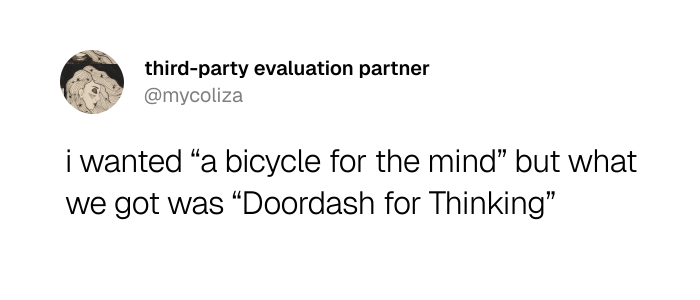
Licklider would call this a (temporary?) example of the "humanly extended machine", where a previously symbiotic relationship has lost its balance, and people now help AI instead of the other way around. With current interfaces, it requires temporarily handing over your agency to AI, which means you trade your future growth and understanding.
In some instances, particularly in large computer-centered information and control systems, the human operators are responsible mainly for functions that it proved infeasible to automate. Such systems ("humanly extended machines," North might call them) are not symbiotic systems. They are "semi-automatic" systems, systems that started out to be fully automatic but fell short of the goal.
Man-computer symbiosis is probably not the ultimate paradigm for complex technological systems. It seems entirely possible that, in due course, electronic or chemical "machines" will outdo the human brain in most of the functions we now consider exclusively within its province.
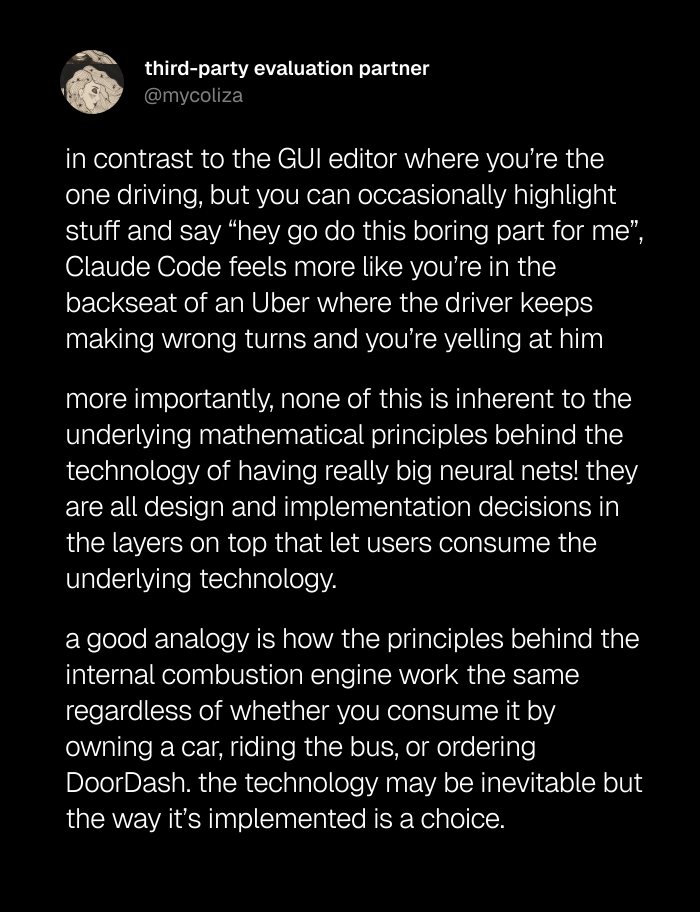
At worst, it adds top-down pressure to increase activity over capability.
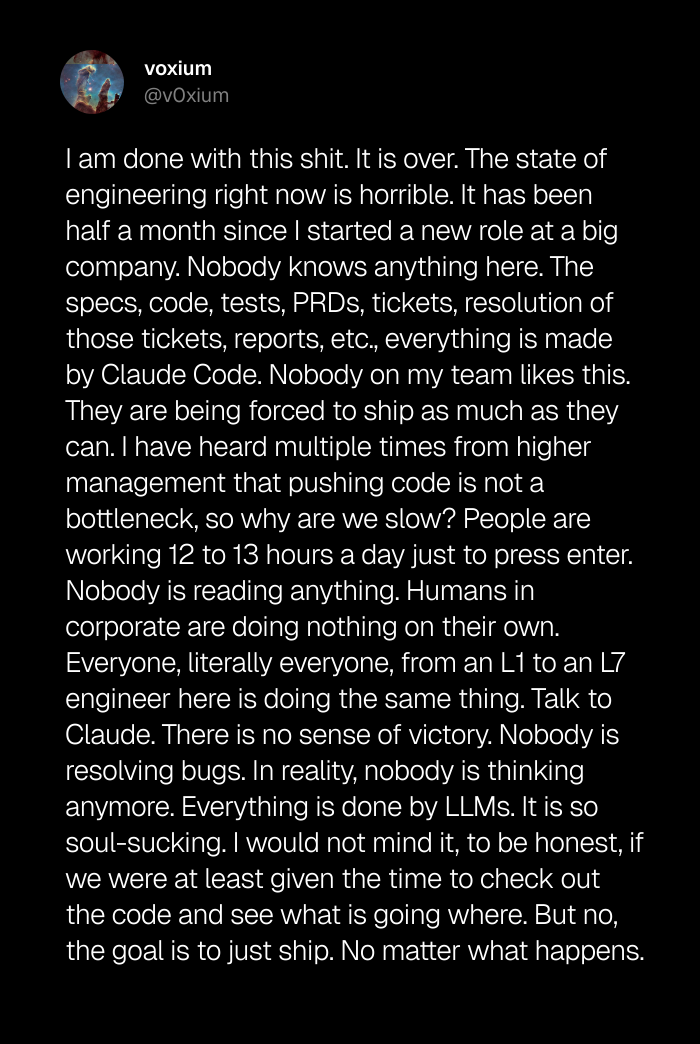
An accidental summary of "Thoughts on slowing the fuck down", by Mario Zechner.
I find this negative of a frame of mind unfortunate.
Even if one were to wave away wellbeing concerns, in a world where there's more software than ever, quality, empathy and care is the most tangible differentiator you can have. Restraint separates the good enough from the greats.
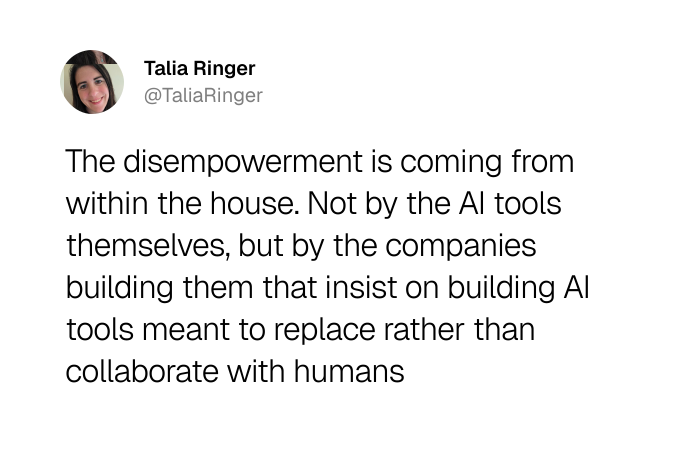
Every company or project should have in their best interests to continually rebalance people back towards symbiosis, even if the way work is done changes.
It's been worrying to see this extend to other fields like mathematics, with similar consequences.
Things intensified after Navier-Stokes was solved by an OpenAI model2, and a 13M lines Lean formalization of Fermat's Last Theorem was released by Anthropic3.
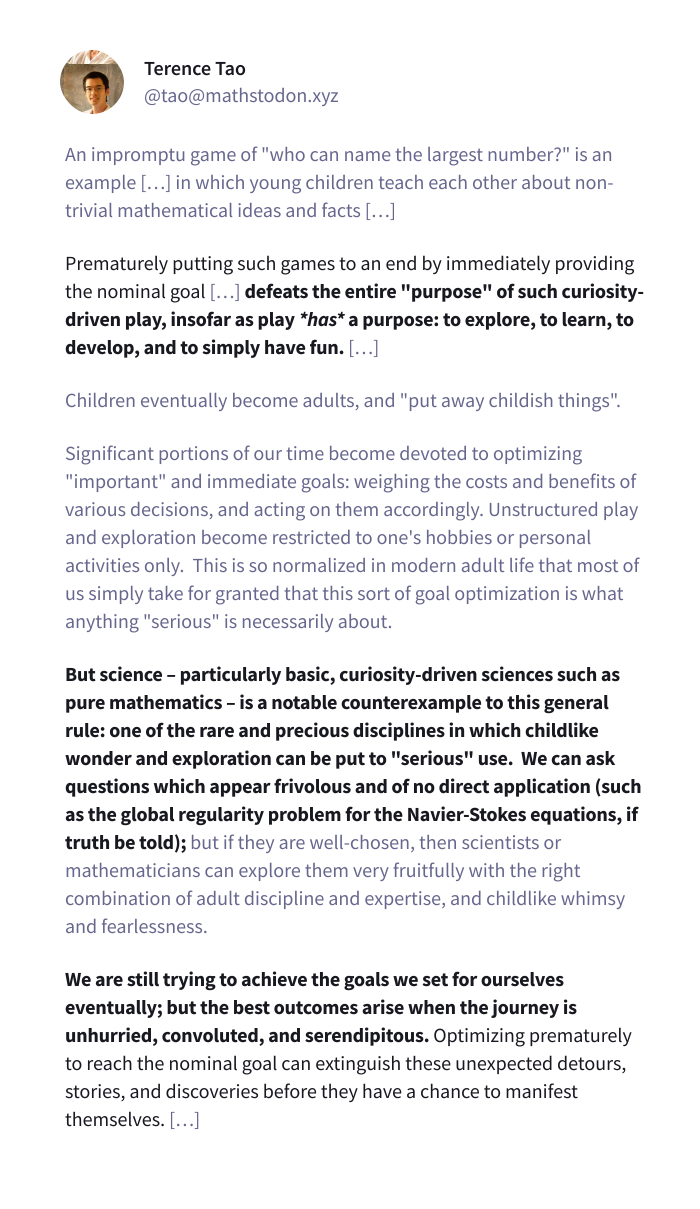
The diagnosis is the same. We need instruments for thought and exploration back on the menu, and not just for a handful of fields.
We can still shape the new ways work and play are done. It must be the role of design to go back to symbiosis.
I wanted to share some thoughts on potential directions, but I didn't want to dilute this message. I'm happy just opening up the conversation on this.
Onward.
Credits and licenses
This post is licensed under Creative Commons Attribution ShareAlike 4.0.
Footnotes
-
Also called a "medium" by Kay and Goldberg ↩
-
https://www.anthropic.com/research/formalizing-fermats-last-theorem ↩